
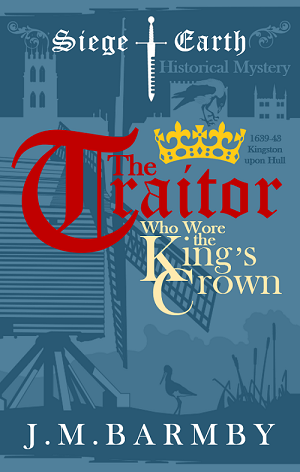
The display of Hull’s excavated historic town walls in the early nineties stimulated the beginnings of The Traitor Who Wore the King’s Crown. A location reputed the ‘birthplace of the English Civil War’, where King Charles I was refused entry to the town in 1642 by a governor who is still reputed a traitor even today. I had first intended to write an English version of The Three Musketeers, but the story I started took on a life of its own. Traitor was first entitled Heaven’s Earthwork as a fictionalised history, but after advice from literary agents I added a mystery and developed the story to fit into the historical mystery/thriller genre and the Intelligencer series was born.
Traitor follows expected tropes and themes, and the main title specifically constructed for the genre. Historical fiction likes great events and eminent persons, kings and queens, while I like to focus on the lives of ordinary people who we may all identify with. The Intelligencer of the story is a man caught between both worlds trying to make good those ordinary lives disturbed by extraordinary events. The seventeen-century was a time of radical social change and civil revolutions and seemed an appropriate epoch, where I could make political comment relevant today, but the novel started with an infamous traitor. Sir John Hotham the once governor of Hull is today thought of with treasonable hypocrisy, for denying a king the city and later sympathising with the Royalist cause. Yet having researched the episode the reputation seems a little unjust, not least because the penalty was execution, for him and his son. In consequence the novel is about interpretation, were things are not always what they seem. The reputation of traitor under the same principle would make many guilty, so I also wanted to explore the notion of what causes anybody to turn traitor, even against themselves.
The story is also partly inspired by Curfew Must Not Ring Tonight by Rosa Hartwick Thorpe, a book given to me by my grandfather in 1983, in turn given to him in 1924. The book handed down to me was published prior to 1888, possibly around the 1870s. Curfew is a narrative poem set during the Commonwealth under the rule of Oliver Cromwell. To save her lover a young woman called Bessie begs the old Sexton not to ring the curfew bell at the hour of execution. When the old man refuses, Bessie climbs the church tower and silences the bell by clinging to the clapper, but the old man is deaf and does not know. When Cromwell learns about Bessie’s heroinism, he grants a pardon to her lover. The novel I have written however does not actually resemble this story.
Excavations are currently underway by Humber Field Archaeology to uncover the South Blockhouse, part of the old defenses on the east bank of the River Hull. It is hoped a visitor attraction may be developed to tell more of Hull’s sometime turbulent past through the excavation, interpretation and display of the South Blockhouse. Learn more from Maritime Hull.
Opinions and views expressed in this post or comments are the authors own (Terms & Conditions).