
Siege of Hvll
Kingston-upon-Hull reputed the ‘Birthplace of the English Civil War’ is where King Charles I was refused entry to the town in 1642 by a governor who is still reputed a traitor even today.
23 April 1642
On Saint George’s Day 1642 a letter arrived at Hull informing the town Governor the King intended to dine with him that day.
The Governor, Sir John Hotham, formerly removed from the post by the King following repeated conflicts over ship money, and objections to the King’s Scottish Bishops’ Wars, during which the King threatened Sir John would be hanged if he continued to protest, was later reinstated as Governor by Parliament.
To make matters worse, Hotham was secretly informed the Royalists intended to behead or hang him as soon as they entered the town.
When the King arrived at Beverley Gate outside his town of Hull, Sir John reused to allow the King to enter. After a day-long negotiation Sir John was proclaimed a traitor by the Royalists.
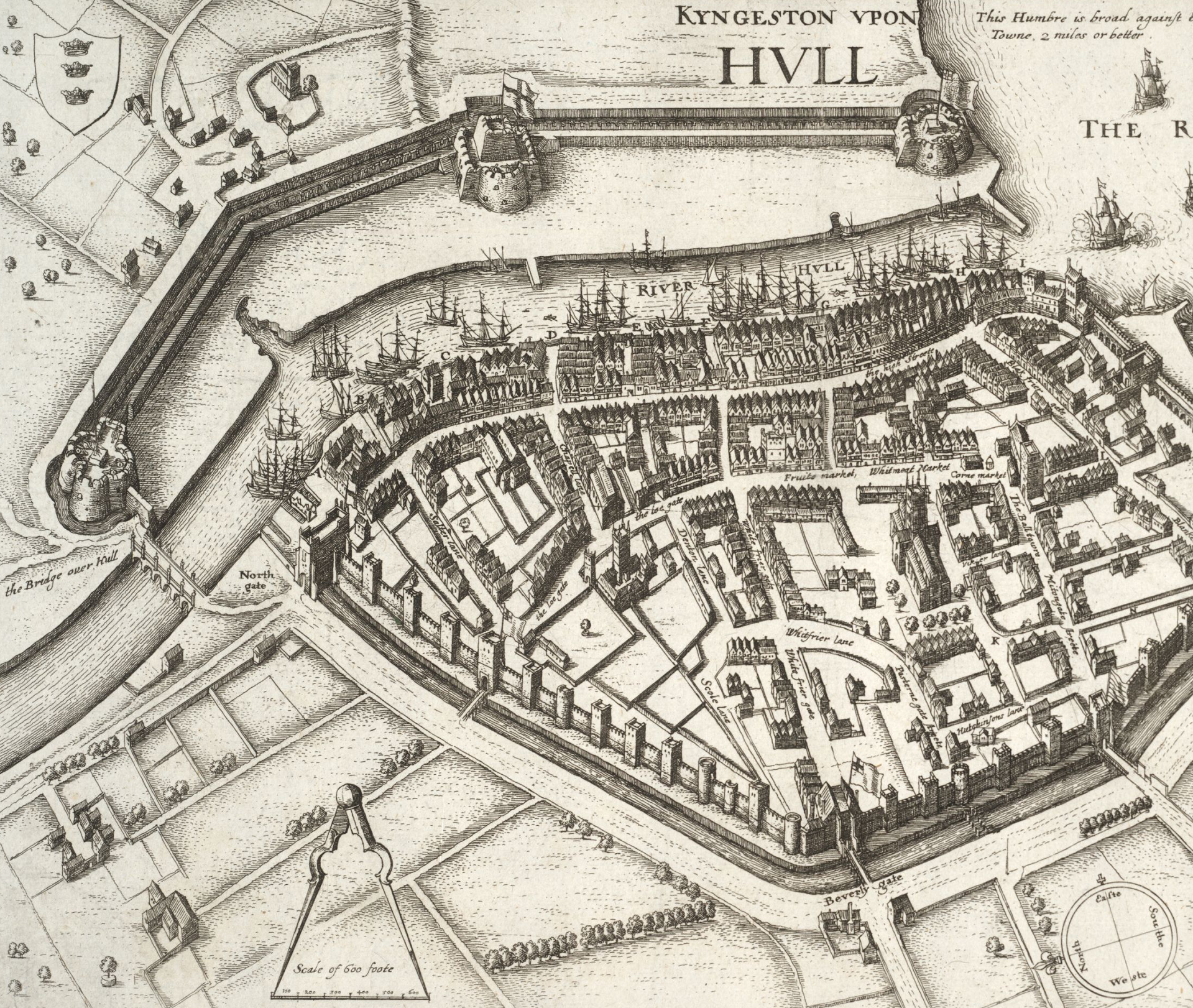
The Royal cartographer, Wenceslaus Hollar, gave a good impression of how Hull may have looked during the 17th century.

Courtesy Thomas Fisher Rare Book Library, University of Toronto
3 July 1642
After plot and counterplot the Royalists besieged Hull, but failing to gain the town after a month the siege was lifted and the King raised his Royal Standard at Nottingham on 22 August 1642. During the following war many high ranking officers and noblemen defected to the Royalist cause, and Sir John’s son Captain John Hotham corresponded secretly with the Royalist side. After an altercation Cromwel reported Captain John to the Committee of Safety and his arrest was ordered. Captain John escaped while being transported to London and returned to Hull. The news broke Sir John’s remaining loyalty to Parliament. In Hull Captain John was re-arrested, but his father escaped, only to be apprehended by one of his own cousins in Beverley later the same day after being struck by a musket butt.
2 September 1643
Such was the Royalist sympathy, soon Hull was the only remaining Parliamentary stronghold in the north. Lord Fairfax and his son Thomas retreated to the safety of Hull’s walls after being utterly defeated at Adwalton Moor near Bradford by the Earl of Newcastle commander of the Northern Association. Newcastle again turned his army on besieging Hull, but with the threat of the King’s safety elsewhere the siege was again lifted and the Royalist army converged in Lincolnshire and York.
10 November 1644
Over a year after the arrest Sir John Hotham was brought before a court martial at the London Guildhall and charged with treachery to Parliament. On 7 December Sir John was found guilty of treason and sentenced to death. On the 9th December Captain John was also tried and found guilty of the same charge with the same sentence. Declared traitor to both King and Parliament Captain John was executed at Tower Hill on 1st January 1645, and Sir John was executed the following day.
Why I wrote The Traitor Who Wore the King’s Crown.
Look Further
Excavations are currently underway by Humber Field Archaeology to uncover the South Blockhouse, part of the old defenses on the east bank of the River Hull. It is hoped a visitor attraction may be developed to tell more of Hull’s sometime turbulent past through the excavation, interpretation and display of the South Blockhouse.
This content is for information only and should not be considered complete or accurate, or perceived as expert or authoritative.
The Intelligencer Begins…
An Historical Mystery Novel
