
BookWyrm
Not a book review
There are many good books I have read, but the following list includes just some which have influenced me.
This page is inspired by my mother Hilary, an avid viewer of sport and reader who once kept a journal of books she had read categorised as F/DNF (finish/did not finish). There are millions of books published every year, absorbing the existing world library would mean reading approximately five-thousand books every day during your lifetime.

Anderson, Poul. The Broken Sword
Austen, Jane. Pride and Prejudice
Bates, Brian. The Real Middle-Earth
Brown, Mary. The Unlikely Ones
Campion, Jane. The Piano
Clarke, Susanna. Piranesi
Cornwell, Bernard. The Last Kingdom
Dickens, Charles. Great Expectations
Dumas, Alexandre. The Three Musketeers
Eco, Umberto. The Name of the Rose
Foster, E.M. Howard’s End
Gedge, Pauline. The Eagle and the Raven
Howard, Robert E. Conan the Barbarian
Le Guin, Ursula K. A Wizard of Earthsea
Livingstone, Ian. The Warlock of Firetop Mountain
Moorcock, Michael. The Runestaff
Perrin, Steve. RuneQuest
Tolkien, J.R.R. Lord of the Rings
Piranesi, Susanna Clarke 2020
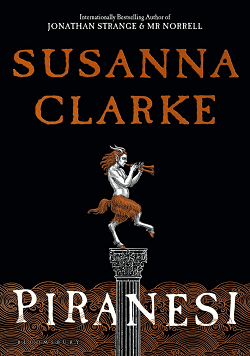
Piranesi’s entire world is a house in which he lives alone. A house with infinite rooms, endless corridors, and vestibules lined with thousands upon thousands of statues, each different from all the others. The lower halls of this labyrinth are washed by an ocean; waves cascade up staircases, and entire floors are flooded. The upper halls are shrouded in clouds, where birds occasional visit. Piranesi dedicates his life to exploring the house as there is nothing else but this world. Apart from the other thirteen people known to have existed, there is only Piranesi and the Other living. The Other visits Piranesi twice a week to find what has been learned of a Great and Secret Knowledge hidden somewhere in the house.
Piranesi logs everything in a journal, which itself contains secrets of his past he does not remember. Eventually, Piranesi is struck by an epiphany: The Knowledge is not the point of the House. “The Beauty of the House is immeasurable; its Kindness infinite.” It seems a little like Borges’s Library of Babel, a world that is an infinite library, with every possible book containing every possible combination of letters. The title of the novel refers, obviously, to the artist Giovanni Battista Piranesi, famed in the 18th century for his etchings of imaginary prisons. The fictional Piranesi does not feel trapped by his prison, he learns to love it, to know its rhythms and wonders, and to see it as a beautiful world unto itself.
Yet, Piranesi is a prisoner of his own imagination. As he explores, evidence emerges of another third living person, and a terrible truth begins to reveal a world beyond the one Piranesi has only known. “Here (in the House) you can see only a representative of a river or a mountain, but in our world (outside the House) you can see the actual river and the actual mountain.”
The Last Kingdom, Bernard Cornwell 2004

The Last Kingdom, the first historical novel in Bernard Cornwell’s The Saxon Stories/Tales consisting of 13 novels, later known as The Last Kingdom series, and turned into a BBC TV series 2015.
What makes the story so compelling is the main character of the novel and his strained relationship with King Alfred (the Great). Born Osbert, Uhtred inherits his father’s name and Ealdorman title after a disastrous attempt to regain the city of Eoforwic (York) seized by the Danes, in which Uhtred’s father is killed and he is captured. Raised a Dane by Jarl Ragnar, Uhtred is blamed for his captor’s death when their hall is burnt down by a Danish rival. Uhtred flees to Wessex, where Alfred sees an advantage in learning about the Danes by conjuring Uhtred into giving his oath. Uhtred spends the novel trying to consolidate his social position and extradite himself from the English embrace in order to regain his own kingdom of Bebbanburg in Northumbria, lost to his treaterious uncle.
Wyrd bið ful aræd.
The Dark Age period has always captured my imagination since The Viking Dig at York and succeeding Jorvík Viking Centre museum and visitor attraction.
The Real Middle-Earth, Brian Bates 2002
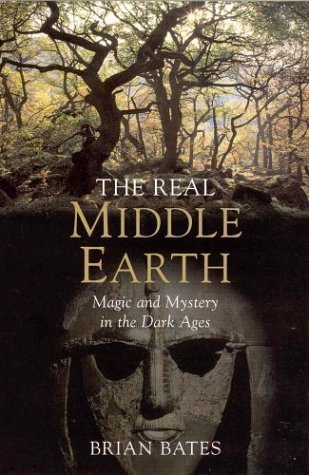
Middle-earth, an Old English term for the Dark Age world made famous by J.R.R. Tolkien, a world of magic, mystery and destiny really did exist, and where many of our histories are placed.
In The Real Middle-Earth: Magic and Mystery in the Dark Ages, Bates explores the very landscape of the Dark Ages, enchanted and imbued with a magical belief system left only in folk memory and fairy tales.
Through archaeological reconstruction Bates reveals a vivid historical culture of this Middle-earth of past times to help us understand our own place in the world today.
The Piano, Jane Campion 1994
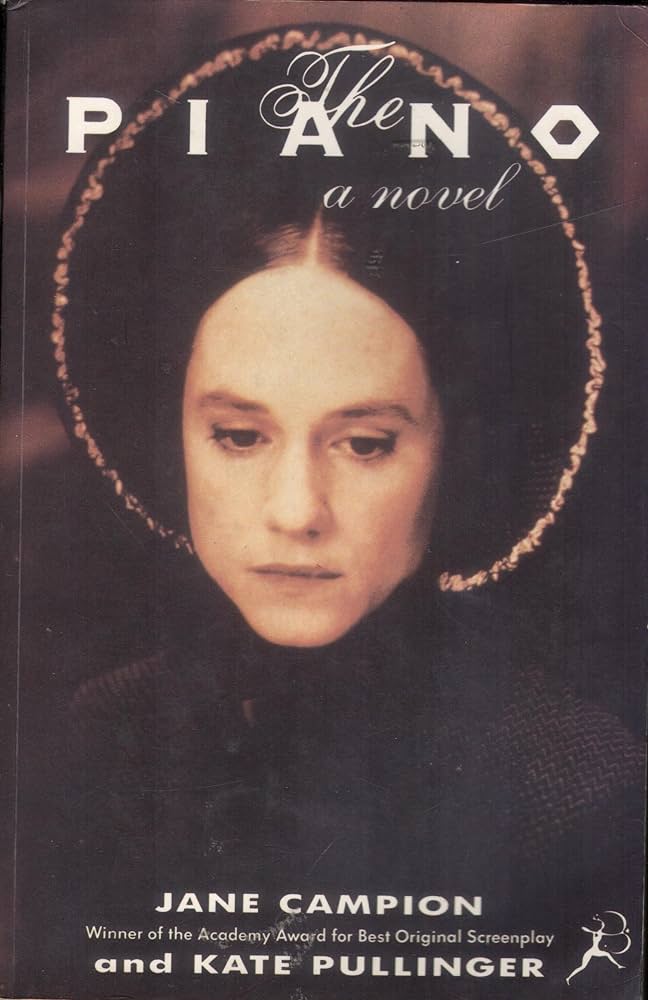
The story of Ada and her piano after an arranged marriage and arrival in a remote New Zealand settlement in the mid-19th century.
A novel by Jane Campion and Kate Pullinger, published after the film of the same name (1993), written and directed by Jane Campion.
Ada does not speak. ‘The voice you hear is not my speaking voice, but my mind’s voice.’ Ada has been mute since six years old, the reason not explicitly revealed, she communicates through sign language interpreted by her daughter Flora. The piano is Ada’s form of expression, and the muteness serves as a metaphor for lack of agency as a woman in the patriarchal society of the 19th century.
The piano and Ada’s yearning for playing are taken away when a local recluse claims the piano left on the beach, and has it transported to his house. In order to play, and eventually reclaim her piano, Ada strikes a seductive bargain with the local who took it. The piano becomes a symbol of what they desire yet cannot have. A dramatic, sensual, atmospheric, and unforgettable tale.
The Unlikely Ones, Mary Brown 1986
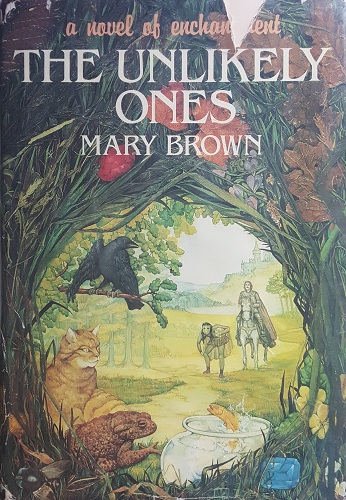
A unique and beautiful fantasy story. The Unlikely Ones begins in the most beguiling way and draws you into the story of Thing and her close circle of animal friends all living under a strange curse of debilitating pebbles.
I came across the novel while in Tobermory, Isle of Mull in 1986, the year of first publication. The title, premise, and book cover ensured I had to read it.
A masked hunchback, crow, toad, kitten and fish escape the domain of a witch and are joined by a rusty knight and unicorn with a severed horn. Perhaps it all sounds just a little too fanciful, but is an unforgettable tale in the tradition of Tolkien, were each member of the party needs the others in order to succeed. The intrinsic nature of the story unravels through a rich tapestry as the friends journey on a quest of discovery which will change their lives forever.
Oh, and did I mention the dragon!
The Warlock of Firetop Mountain, Ian Livingstone & Steve Jackson 1982
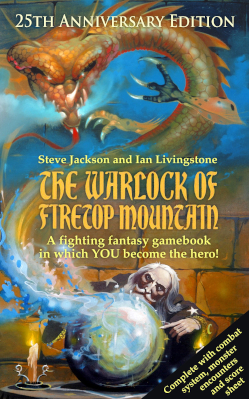
The Warlock of Firetop Mountain is the first in the Fighting Fantasy book series from Ian Livingstone and Steve Jackson, who formed the great Games Workshop in 1975, bringing us the U.S. role-playing game Dungeons & Dragons, the White Dwarf magazine, Citadel Miniatures and Warhammer. Also publishing UK reprints of American RPGs such as Call of Cthulhu, Runequest, Traveller, and Middle-earth Role Playing.
The Fighting Fantasy titles, Warlock of Firetop Mountain, City of Thieves, Forest of Doom, and others, are solo role-playing dice-based game-books. In a world of adventure where you the reader are the hero, and the choices you make decide the outcome of the tale. Turn to paragraph 400 – Your Quest is Over – You have succeeded in your quest, and the people are joyous once again.
O, for the golden-age of 80s role-playing games.
The Name of the Rose, Umberto Eco 1980
(1983 English translation)
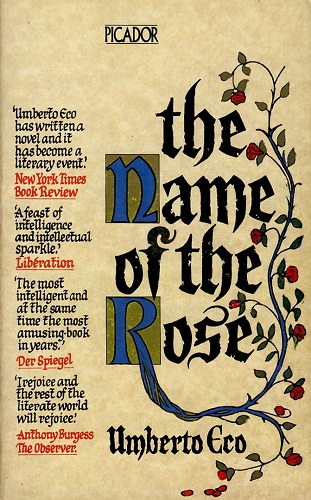
The focus of Umberto Eco’s first novel The Name of the Rose is a labyrinthine library and the interpretation of knowledge it holds. In the story the first-person narrator Adso of Melk, an aged Benedictine monk, tells of his recollections of events that took place in a remote Italian abbey in 1327. Under the tutorship of the Franciscan friar William of Baskerville, the novice Adso investigates a series of mysterious murders at the abbey, which are connected to the reading of restricted books from the library.
For me this novel represents the gold-standard of historical mysteries. It has been suggested (in Naming the Rose: Essays on Eco’s ‘The Name of the Rose’) Eco’s novel pays homage to the Sir Arthur Conan Doyle’s Sherlock Holmes stories, as well as Voltaire’s Zadig, alluding to the detective reasoning and methods employed by Holmes, as if they were witchcraft.
Eco’s depiction of the labyrinthine library symbolises the medieval quest for knowledge, and the suppression and restriction of knowledge in a time when medieval pilgrims sought out the labyrinths of cathedrals, such as Rheims and Chartres to contemplate the texts of great minds. At the end of the novel the whole library, the labyrinth of the world, is destroyed by an apocalyptic fire.
I first read The Name of the Rose in my mid-twenties, ten years after it had been written. The novel captivated my interest in old books and medievalism. I had in my head at the time my own medieval sanctuary story, and found Eco’s novel in a second-hand bookshop. I had also recently read a spate of stories set in the medieval period, Domini Highsmith’s novels of Beverley and the Cadfael series by Ellis Peters. I found Eco’s whole writing style captivating. It felt as if the author himself was a possessor of that masterful wizardry and transmitted from the page.
The Eagle and the Raven, Pauline Gedge 1978

A story of Boudicca, the most famous warrior queen of ancient Britain, and Caradoc, the son and resistance leader of a Celtic king.
Caradoc sets out to unite the people of the Raven and lead them against Rome. Caradoc’s campaign is met with fierce opposition from a northern queen who has sworn allegiance to the Romans, and his own warrior sister who falls in love with her Roman captor. When Caradoc’s endeavour end with imprisonment, a strong-willed warrior queen, Boudicca, ultimately takes up the cause of freedom.
This is the story of a fiercely proud, mystic people, from misty mountain high to deep oak forests, tribe to tribe, who fought for generations to hold off the Roman conquest in a bloody struggle to maintain their very way of life.
RuneQuest, Steve Perrin 1978
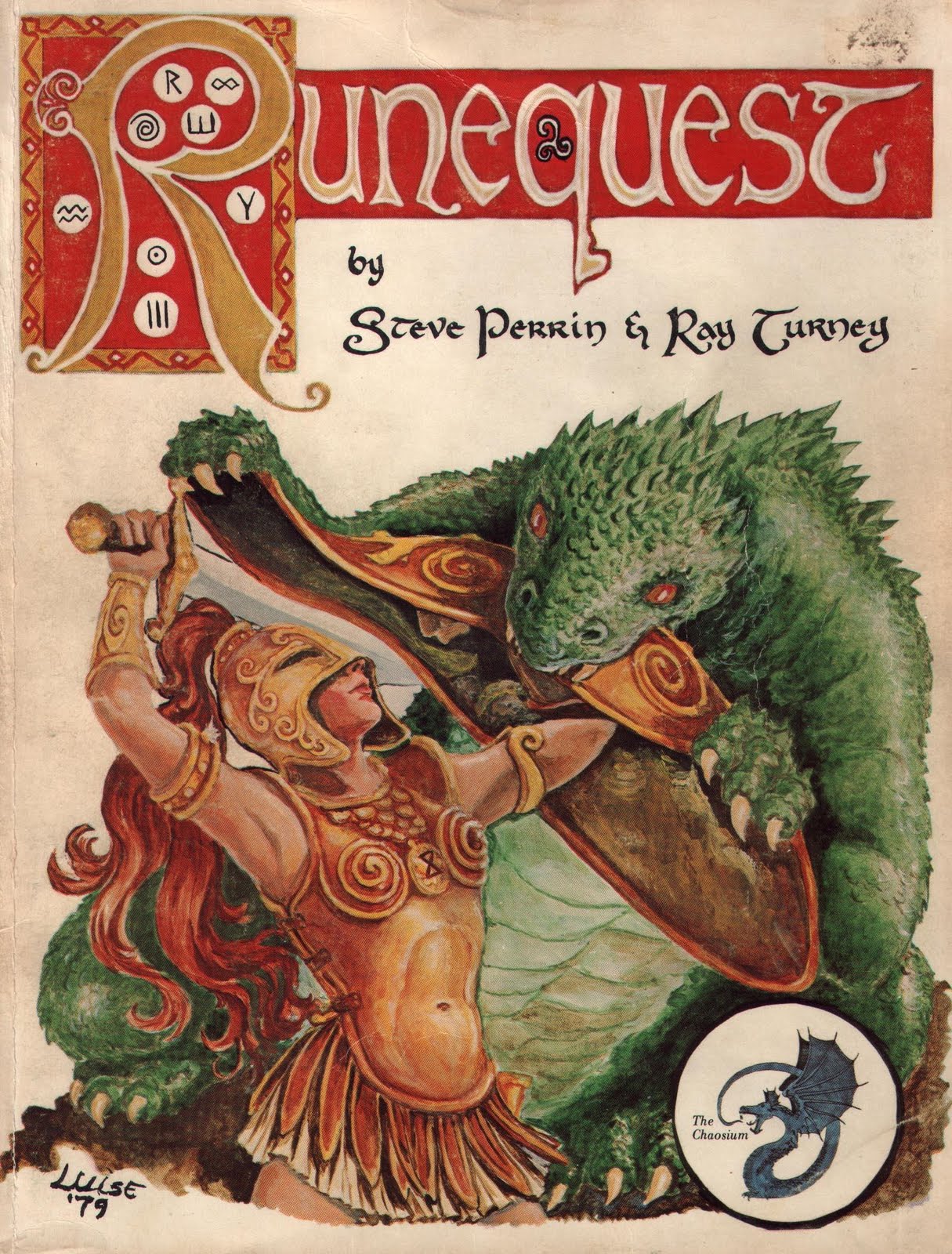
RuneQuest, first published in 1978, is a fantasy tabletop role-playing game originally designed by Steve Perrin, Ray Turney, Steve Henderson, and Warren James, and set in Greg Stafford’s mythical world of Glorantha.
In 1975, game designer Greg Stafford released the fantasy board game White Bear and Red Moon, later renamed Dragon Pass, produced and marketed by The Chaosium, a publishing company set up by Stafford specifically for the release of the game, who also published numerous companion supplements. Steve Perrin developed the original game system RuneQuest (RQ), which became the second most popular fantasy role-playing game after Dungeons & Dragons.
The core RQ rules formed a generic role-playing system used in the games Stormbringer (1981), Call of Cthulhu (1981), ElfQuest (1984), Pendragon (1985), and Hawkmoon (1985), among others during the 80s golden-age of TT-RPG. I am most familiar with the 1984 third edition of RQ published under agreement with Avalon Hill, and released in the UK through Games Workshop. RQ3 became known as the ‘Dark Ages of fantasy Europe’, which started my love of TT-RPG.
The Runestaff, Michael Moorcock 1969

First published as The Secret of the Runestaff, is a series of fantasy novels and a version of the Eternal Champion. In a post-apocalypse dystopia and alternate history Dorian Hawkmoon embarks on a quest for the grail-like staff. The Eternal Champions are appointed paladins of balance, most possessing an unbreakable bond with the sentient chaos-aligned sword called Stormbringer. Stormbringer, the magical sword featured in a number of fantasy novels by Michael Moorcock, is a black rune sword created by chaos and wielded by the weak albino Elric Melniboné, the Eternal Champion, from which he draws strength by stealing souls of victims. Ultimately, Elric’s reliance on Stormbringer proves his undoing, when eventually the sword kills him.
In another series, The Swords Trilogy & The Chronicles of Corum, Corum is also an incarnation of an Eternal Champion. A hero losing his left hand and right eye early in his first story. The hand and eye are later replaced by powerful eye and hand artifacts which help Corum against his enemies. In The Secret of the Runestaff the quest for the Runestaff sends Hawkmoon into a landscape of ancient cities, scientific sorcery, and great flying machines.
A Wizard of Earthsea, Ursula K. Le Guin 1968

A Wizard of Earthsea, the inimitable magician apprentice story. I first read the trilogy of Earthsea; A Wizard of Earthsea (1968), The Tombs of Atuan (1971), The Farthest Shore (1972), while still at school. Earthsea is a relatable more human place than most fantasy worlds and of fully rounded characters with moral and individual endeavours. “The rythmic structure of narrative is both journey-like and architectural.” Le Guin has said, “Great novels offer us not only a series of events, but a place, a landscape of the imagination which we can inhabit and return to.”
The telling of AWoE has the feel of a Nordic saga and the magic contained by the School of Wizards on the island of Roke, some holistic organism which effects all things should the balance move. The mastery of magic in Earthsea is obtained by the knowing of true names in Old Speech, the language of dragons, and why Ged is given the name Sparrowhawk. The idea of language being the epitome of power as opposed to mere spell casting is compelling for all writers and readers alike.
Lord of the Rings, J.R.R. Tolkien 1954/5
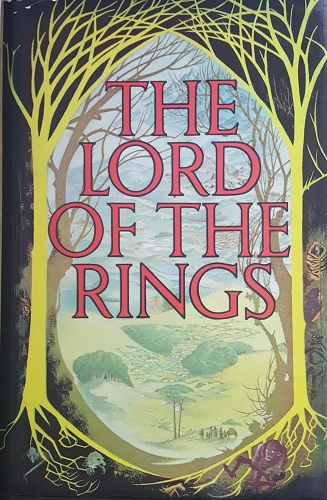
I had to start with Lord of the Rings by J.R.R. Tolkien, published in three parts, The Fellowship of the Ring, The Two Towers and The Return of the King. Perhaps the one book that has had the greatest influence on my writing, and perhaps my life, not least because of its connection to RPGs and themes of environmentalism. Tolkien’s love of trees and unspoilt nature is evident throughout the novel. An epic high-fantasy tale and a re-imagining of the Anglo-Saxon world. I always say the LotR is not a fiction, but history, as many elements and themes in Tolkien’s work have been drawn from Norse mythology and our ancient myths and literature. Not least Middle-earth itself, a place that really did exist. Middangeard was an Anglo-Saxon term used around AD 0-1000, for the surface of the earth where people lived. Middle-earth was born from the concept of an upper-world above and under-world below, with humanity placed between these two great realms.
I was introduced to LotR as a teenager by an Aunt and Uncle and I was spellbound. I took the book on a holiday to Scotland and I could not put the tome down until I had read it from end to end. LotR has been highly influential on those wonderful educational tools, RPGs, another great influence on my early self, and on the many fantasy novels that came after. It is perhaps LotR that inspired me to write novels where history and fantasy meet.
The Broken Sword, Poul Anderson 1954

The Broken Sword is a sword and sorcery novel by Poul Anderson first published in 1954. A fantasy version of the Viking Age and containing references to Norse mythology, the chronicle follows Skafloc an elven-fosterling, and Valgard the changeling, who are exchanged as infants. And so, ensues a saga of gods, faerie, and man, where trolls war with elves, and a tragic love story unfolds. Michael Moorcock himself declared The Broken Sword influenced his own Elric of Melnibone series featuring the sword, Stormbringer, which has many similarities to Skafloc’s sword.
The first edition of The Broken Sword (1954) contains many archaic spellings and acknowledged by Anderson as an ‘unrelievedly savage’ composition from his younger self, with the later (1971) revision some consider to have weakened the novel.
Conan the Barbarian, Robert E. Howard 1932

First published as The Phoenix on the Sword in Weird Tales magazine, adapted from an earlier unpublished story Kull the Conqueror titled By This Axe I Rule!. The Conan stories have become foundational to the modern fantasy epic.
Robert E. Howard is often considered the father of the sword-and-sorcery genre, sadly his greatest success coming after his lifetime. He remains one of the best-selling fantasy writers of all time, Conan has never been out of print. Howard’s legacy spans into publications of other authors completing his unfinished manuscripts and new work featuring his characters.
For me it started with the film Conan the Barbarian (1982) directed by John Milius, co-written with Oliver Stone, and staring Arnold Schwarzenegger, and the following Conan the Destroyer (1984), directed by Richard Fleischer, and then the spin-off Red Sonja (1985). Schwarzenegger’s casting and stoic performance brought a raw, authentic realism to the fantasy genre.
Read the full story Conan the Barbarian: The Official Story of the Film by John Walsh.
Howard’s End, E.M. Foster 1910
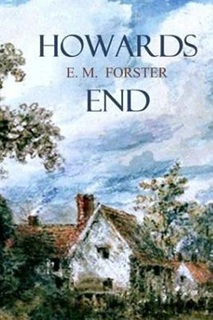
Howard’s End is a story about social interaction from three class backgrounds, the business capitalist, the intellectual middle-class, and the working-class, all revolving around real estate, and featuring an old country cottage, Howard’s End.
Foster’s father was an architect, and in an essay, Foster described the novel as ‘a fight for a house’ and about ‘the possessions of England’, in which, at the end, the house is inherited by those at the lower end of society.
Only connect, the relationship of prose and passion between differing people regardless of background is the epigraph of Howard’s End, itself mentioned in the novel. “Only connect! That was the whole of her sermon. Only connect the prose and the passion, and both will be exalted, and human love will be seen at its height. Live in fragments no longer.”
As with many novels, I watched the movie (Merchant and Ivory 1992), several times, before reading the book.
Great Expectations, Charles Dickens 1860-61
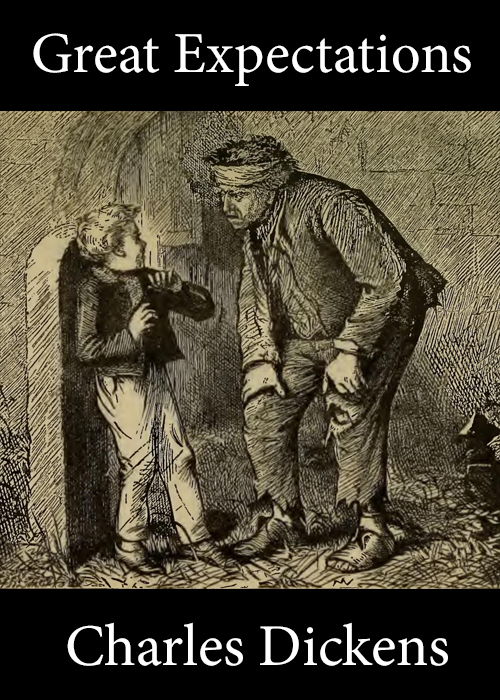
One of Charles Dickens most enduring novels, published in serial form in Dickens’s weekly periodical All the Year Round, from 1st December 1860 to August 1861. In October 1861 Chapman & Hall first published the novel in three volumes.
Great Expectations is full of vivid descriptions, with well developed characters, an engrossing plot, and another story that only becomes apparent at the end. One of Dickens later works, it has a lot to say about the human condition, class struggles, corruption, and fairness and justice in the world.
Dickens once claimed that David Copperfield was his “favourite child”, and that Great Expectations was a close second. It is no coincidence that both novels are about the developement and growth of young characters, but of the two Great Expectations is shorter, sharper and has got better with age. Lessons in the story still hold true. The consequesences of our actions have outcomes we may never have anticipated, and these choices can leave long-reaching impressions on those we never knew we touched.
The Three Musketeers, Alexandre Dumas 1844
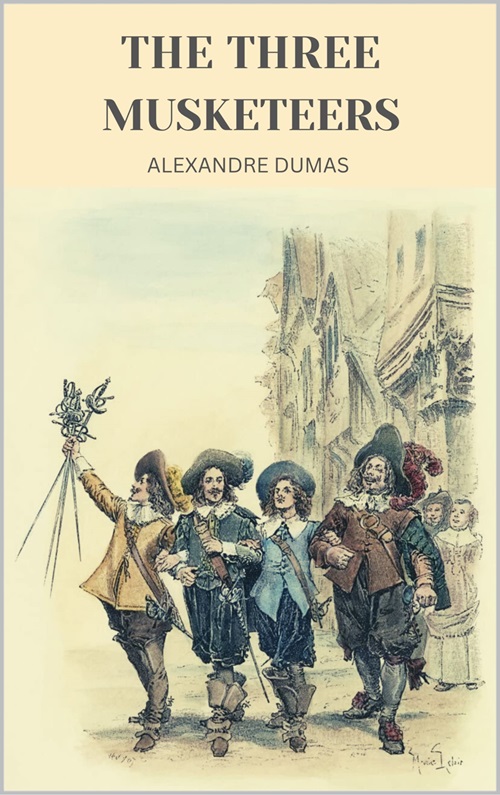
The Three Musketeers is the story I most loved as a youngster, but I didn’t actually read the whole novel until much later. I first became acquainted with the 1973 film version directed by Richard Lester, script by George Macdonald Fraser and staring Michael York as D’Artagnan, Oliver Reed as Athos, Frank Finlay as Porthos and Richard Chamberlain as Aramis.
After reading the erudite and witty novel, I realised the 1973 film was very true to the story in the book, encapsulated the very humour and friendship emitted from the pages of Dumas’s novel.
Under the surface the novel is actually a complex exploration of character and motive, where hero and villain are all a matter of perspective. At one point, after visiting many re-enactments, I actually became a musketeer myself joining the English Civil War Society. I met some clever and brilliant people then and that insight into the period helped me with my rendition of the intelligencer novels.
Pride and Prejudice, Jane Austen 1813
I first watched the 1995 BBC drama TV adaption by Andrew Davies and was hooked on this witty and charming love story. I have always been a hopeless romantic, and quite possibly a bit of a Darcy. Then of course I had to read the novel.
Pride and Prejudice the second novel by Jane Austen was published in 1813, a brilliant exposition of eighteenth-century society manners, in which every single character completely captivates the story. Austen manages to entertain through the whole novel with brilliant dialogue and an enthralling narrative.
“I should infinitely prefer a book.”
Jane Austen’s house (museum) in Chawton, Hamshire, where she lived and wrote her novels is worth a visit.