
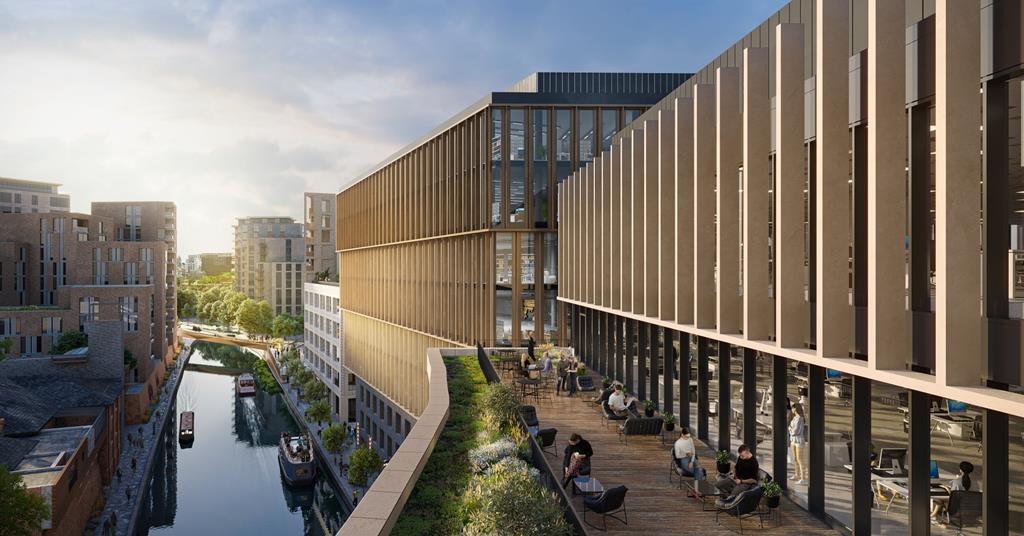
Tribeca, a mixed-use development with a state-of-the-art laboratory and office spaces across six floors, is the first project to have demonstrated the use of Earth Blocks, where excavated clay from the construction site mixed with sand and straw has produced unfired bricks for the Apex building.
Part of The London BioScience Innovation Centre (LBIC) in King’s Cross London, the Tribeca project aimed to improve sustainability by using the site subsoil (clay) combined with sand and straw to create unfired bricks known as earth blocks. The earth blocks tested to British standards, regulations, and strengths, have been used to create the lower-level perimeter walls of the Apex.
It will be the first building of its scale to make use of site subsoil as a construction material, and the aim is to set a pioneering precedent on using earth blocks for the construction industry. There are currently manufacturers producing compressed cob earth blocks commercially within the building industry and for use in historic building conservation.
Unlike standard blockwork, which has limited recycling potential, earth blocks may be broken down and reused or returned to nature at the end of their lifespan. This natural material also brings climatic benefits to buildings, by regulating indoor temperature and humidity levels, as well as being a sustainable natural building product. Earth Blocks are not subject to fire or termite because they are strong and not comprised of edible ingredients. A stabilized earthen buildings can last centuries.
Alongside the construction project, the architect team from Bennetts Associates created ‘Earthcycle: Earth blocks from subsoil’, which was exhibited in the 2022 Royal Academy of Arts’ Architecture Summer Exhibition. The piece told the story about the financial and environmental benefit of utilising site subsoil as a construction material.
https://www.bennettsassociates.com/news-and-insights/earth-blocks-tribeca
Opinions and views expressed in this post or comments are the authors own (Terms & Conditions).