
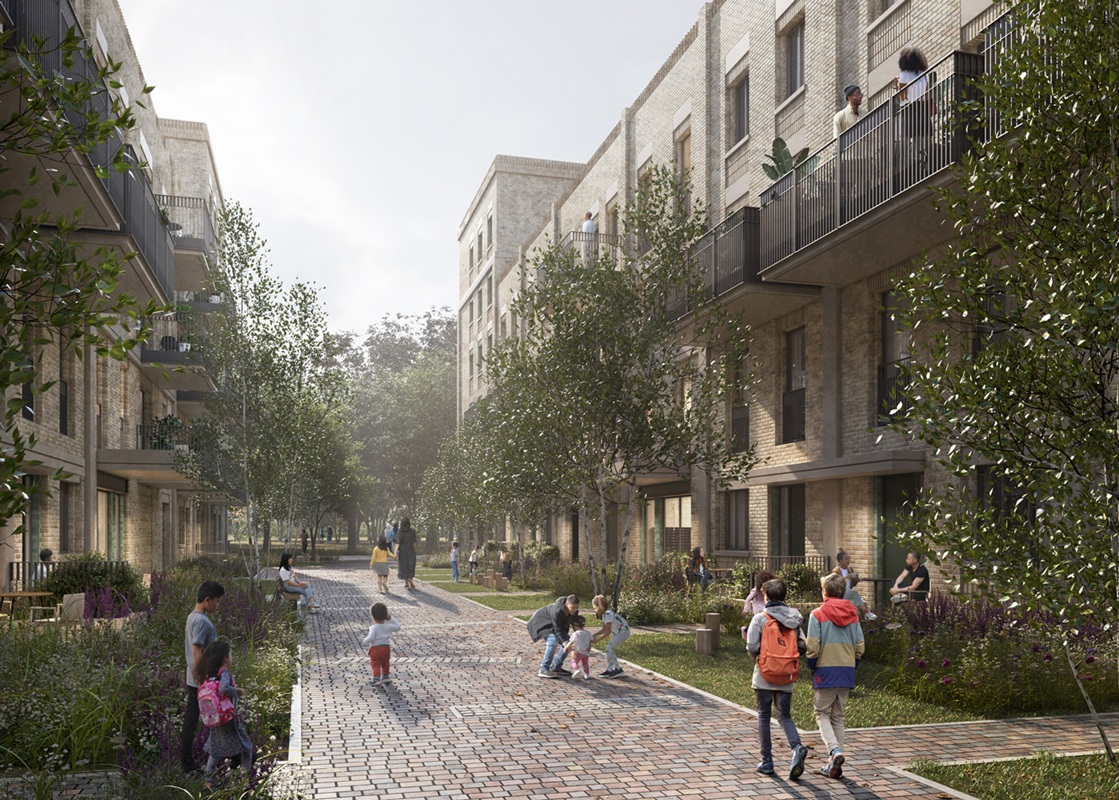
A growing number of London borough councils are increasingly incorporating Passivhaus developments into their housing programmes.
The London mayor has urged more projects built within the Greater London Authority (GLA) to go beyond building regulations through Passivhaus, promoting higher levels of energy efficiency for new homes & buildings.
The London Plan includes a requirement for major developments to comply with the net zero-carbon target by following a energy hierarchy and maximising on-site carbon reductions. A minimum on-site reduction of at least 35% beyond Building Regulations is required for major development. This is expected to rise to a minimum target of 50%.
Energy efficiency is the first stage of the energy hierarchy in the London Plan. Energy demand is reduced as far as possible before the heating strategy and installation of low carbon and renewable technologies are considered. Energy efficiency measures of Passivhaus help to keep homes warmer in winter, cooler in summer, and reduce resident bills. This is why local authorities must retain powers to set standards above national regulations, which continue to be inadequate.
Since June 2022, applicants should also report the Energy Use Intensity (EUI) and the space heating demand of the development. These metrics help applicants to demonstrate they have maximised energy efficiency measures in line with the energy hierarchy, in addition to the percentage improvement target.
Passivhaus lends to help meet the London Plan. The first stage of the energy hierarchy requires residential developments to achieve a 10% reduction in carbon emissions over building regulations through energy efficiency measures. This can be made through fabric and ventilation improvements employed by Passivhaus buildings. Passivhaus also helps to avoid the ‘performance gap’ and achieve real savings in energy consumption for residents.
Space heating benchmarks, although targets are not mandatory, need to be reported against any shortfall. It is clear figures are only achievable with Passivhaus levels of fabric performance. Though it is not stated in the London Plan or the Energy Assessment guidance, reporting includes Passivhaus as an acceptable route. Large scale Passivhaus buildings can often deliver good overall energy performance without the need for low U-values, due to the savings made by their low form factor. This can potentially offer project cost savings, without sufficient levels of insulation, thereby limiting U-values set out in Part L building regulations.
The London Plan is currently encouraging largescale heat networks as a low energy heating method. Passivhaus may integrate well with heat networks, which has been seen in countries where they are more established, however low heat demand of Passivhaus buildings means they can already meet zero-emission heating requirements without the benefit of a heat network. Forcing projects to connect to district heat networks could also unintentionally push projects away from improved fabric efficiency, while also affecting network energy distribution losses. It is clear the UK Building Regulations, recently updated as the Future Homes Standard 2025, is already out of date.
Future Homes Standard not fit for the future – J.M. Barmby
The London Plan and Passivhaus
Opinions and views expressed in this post or comments are the authors own (Terms & Conditions).